I Swear I’m Not Making This Up

Picking up where we left off yesterday….

So mid-morning yesterday I am in my backyard with my oldest dog, letting her pretend to pee for the third time in an hour.  Really she wants to sneak behind the woodpile and through the raspberry bramble to the drainage pipe outlet.  (As mentioned in Downy in the forest, one of my dogs has been interested in culvert inspection since an early age.)

So off we are headed for the PVC pipe (PVC not to be confused with premature ventricular contractions, incidentally) and suddenly my brain is registering a cat fight in the woods.  Only this cat fight includes more than hissing and high-pitched screeching: one of the participants is growling savagely – as though saving its life or ending another life is already a foregone conclusion and the growling is some sort of awful finishing blow.

I look toward the sound and see an animal about the size of a ten pound dog  climb down from one of these trees and amble away as quickly as possible.  (Its movement reminded me of the several times I’ve had the opportunity to watch a porcupine move through this same patch of woods.)

DSCN4449

I pick up my dog and jog her back to the house, then turn and run back towards the half of our lot that is wooded – this is where the sounds are coming from.  Before entering the trail that leads from lawn to lake I grab my husband’s pitchfork, which he has leaned up against a tree trunk at the head of the trail.  (Pitchfork, you ask?  I’ll tell you another day.)

Pitchfork in hand, I am running over slippery dirt and roots (of the sort mentioned in Turtle in the fast lane) toward the sound of killing. The terrible sounds have moved into the thicket of underbrush that covers our shoreline, so I cannot easily move closer to the sound, though I try.  I am stopped by a huge pine that is difficult to get over or under, and I am further hampered by the slip on clogs I have on my feet.  I also have a healthy dose of “You idiot STOP moving in the direction of those animals” racing through my head.  This is smart for two reasons:  (1) Whatever is being attacked is by now either dead or very badly hurt and would almost certainly be better off dead, and (2) assuming neither my neighbor’s dog nor somebody’s infant is being killed, I really should mind my business because animals eat each other every day.

Yet still I find myself determined to understand what I am hearing, so I grab my kayak, abandon the pitchfork, and launch myself into the lake.
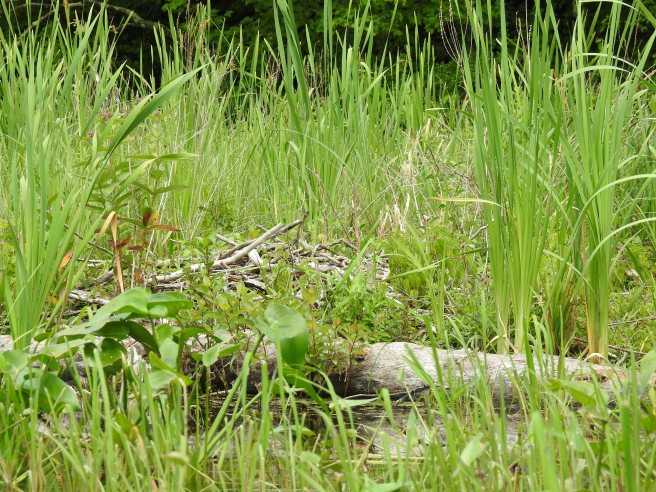
DSCN4433I quickly paddle close to shore in the direction that the sounds have been coming from. I have no plan.  I expect at best to see something awful from a distance.  What I do not expect is to smack a an already frightened and/or angry creature on the head.  But this must be what happened, because within seconds of being in the water my arm muscles tell my brain there is an odd weight on the left hand side of my kayak paddle; my ears tell my brain something is screaming at me; and my eyes tell me that a really angry rodent is literally clinging with both paws to my paddle, teeth bared, screaming mad at the world.

I am concerned that this furious creature will climb the paddle or simply jump at my face and bite me, so somehow I have the presence of mind to dunk this clinging creature back into the water.  I simply redip the paddle into the water and then keep paddling.  Thankfully he has had the presence of mind to let go.  Once I’ve moved off by a few boat lengths I turn and see that the scared little guy has swum to the log that lies at the front of the stick lodge pictured above.  He has climbed onto the log and he is hunched up and making these pathetic cries that for all the world sounded like he has lost his mother.

Twenty feet away this little creature’s twin is similarly hunkered up on a mound of cattails and marsh grass, also making the same sad crying sound.  But the second creature is much closer to the sound of the hidden skirmish, as I sit in my boat and watch him he paws and noses at an opening in the dense stand of vegetation and then disappears in the direction of his interest.

Here are some photos from trees that are located on our shore and not more then ten feet away from the lodge (or den or feeding hut) that the first creature swam back to.

Here’s the thing: I have seen muskrat on this lake from ten feet away, as noted in Ondatra zibethicus (Or, Mr. Muskrat).  These two animals did not look like muskrats – at least not to my frightened and untrained eyes.  Their coloring was too varied – though maybe wet fur and the play of light and water are throwing me.  I didn’t get a look at a tail, so that is no help.  I remember numerous small sharp teeth, not huge front teeth – so no beavers  The more I talked this through with my husband last night, and thought about the form of movement I saw on the earth, and the postures I saw on the log, and the coloring, and the shape of the face that was screaming at me, the more I want to identify these creatures as raccoons.  But why would two baby raccoons be swimming around a muskrat lodge?  And who came down from that tree?

Now, it is possible that the creature being killed was already in the dense vegetation.  Many ducks and geese have been nesting in these areas.  And though I can not describe for you here and now the full vocal range that was involved in the attack/fight/resistance, there are two occasions at least when I thought I was hearing a duck die.  (A chick or gosling or duckling, perhaps.)  And maybe the predator was winged – an owl or eagle?  And the animal running out of the tree got caught in the cross fire?

I have no idea.  I plan to spend the next few months watching and listening and looking for clues that could help put some of these pieces together.
DSCN4482

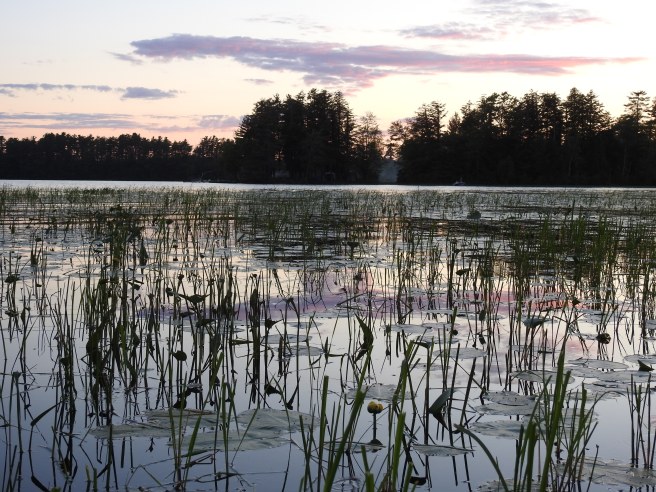
I went back out tonight to sit near the little stick house and see what I might see.  I found a lovely dusk.
 

Late breakfast….

DSCN4431
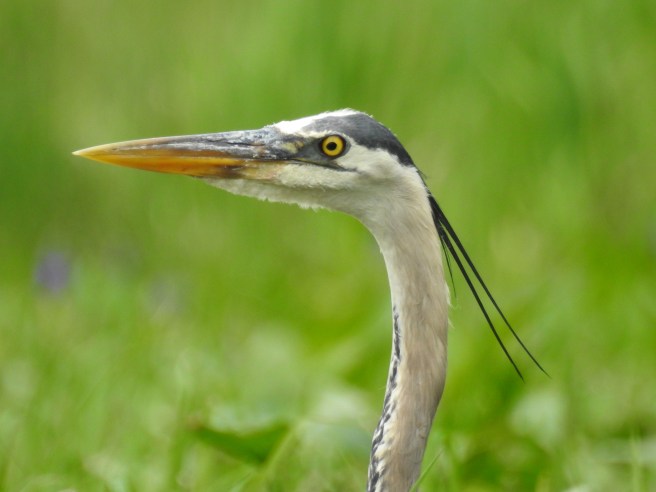
Great Blue Heron
DSCN4468
Little green frog

The best adventures are the kind that nearly require you to call 911.  Such was the adventure I had today.  Highlights include a battle to the death that sounded like the worst cat fight you’ve ever heard at 3:00 am, a pitchfork, and one enraged ten pound rodent CLINGING TO MY KAYAK PADDLE, teeth bared.  As one of my favorite authors, Dave Barry, would say, “I swear I’m not making this up.”

So the pictures above were taken many hours after my heart stopped pounding  hard enough to cause me significant concern.  (My heart has been on the fritz lately, but nothing too serious.)  The heron landed about twenty feet off my left shoulder while I was staring into the dense underbrush where the incident had occurred, trying like the best detective possible to piece together the facts.  The little green frog was nearly under foot on an ill-conceived but well-executed tiptoe through pucker brush looking for animal tracks in the muck to help me identify which of the creatures in my backyard got inadvertently bonked on the head with my paddle and came up ready to bite.

The story is such a good one that I am going to wait until I am actually awake to write it.  I’m also going to attach the only photos I have that give clues (or red herrings) as to what sort of animal I was dealing with.  I already talked the details through with a friend who knows Maine wildlife better than most of us ever will, and he’s putting his money on a fisher being involved.  Stayed tuned, folks.  Tomorrow night is only 24 hours away.

Summer was…

100_0677

Box fans.  Kool-Aid.  Chlorinated pools.

The top bunk.  A lake breeze fluttering the homemade curtain all night.  Listening to wavelets kiss the rocky beach.  “No digging in the clay!” –  and digging anyway.

Mosquitoes in the tent, buzzing in my ear.  Sunburns.  Crab shells by the seashore.

Green quart baskets filled with strawberries.  A garden growing corn, carrots, pumpkins, peas.

A tree cabin in the woods.  A stream conjured up from the outflow of a drainage pipe, with plans for a fish pond and flower garden.  A hammock strung between two oaks.  Bike rides. Sparklers in the backyard. I am eight, nine, ten and the summers are endless.


Downy in the forest

DSCN4375

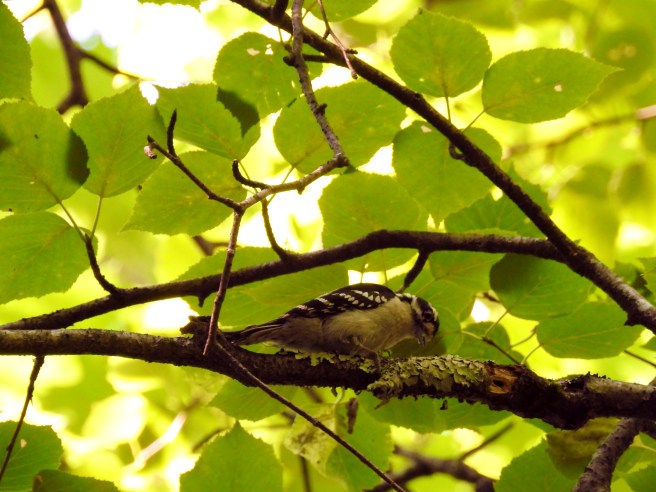
Downy woodpecker searching for breakfast. Heard her (the male has red on its head and although I can’t be certain I think this is a female) while walking the dogs on one of our favorite trails this weekend.  The trail loops through the woods near the first house we lived in when we moved back to Central Maine ten years ago.  The path is wide enough for adults and children and dogs moving in both directions to pass each other without excessive chaos.  There is one cut-through, one loop out onto private property, and now one short cut I’ve made for myself.  There is also a trail that cuts away from the main loop and for a distance follow a brook.  There are no scenic vistas or anything of the sort – by all accounts these are ordinary trails.

It is the ups and downs that I’ve walked and jogged and sprinted and hobbled through that make this network of trails extra-ordinary.  It is the bend in the stream where I stood one cold November morning and somehow knew that my cousin was gone.  And it is the fallen tree across the pond’s outlet where I hunkered down to sob out the loss of my father.  It is which-rock-I’ll-never-know that ripped my husband’s ankle to shreds.  The strangers we’ve passed so many times we now count them among friends. The rock I always hide behind to pee.  The culverts my dog wants to climb through – every single time.  The deer that graced the thick woods with their presence before the clear cut.  And the views of my old house that I refuse to glimpse through the trees.

As 20th century Spanish poet Antonia Machado said, “Travelers, there is no path, paths are made by walking.” That is –  we make the path by walking.  I have walked this path through all four seasons many days a week for many years.  This was so much easier to do when I could walk out of my back door, cut through 50 feet of woods, and hit the trail.  Our move made this quick walk a brief car ride, but most days when I step onto that path I feel like I am with an old friend.  Having an old friend to return to is especially important when the path forward is so hard to see.  Learning to expect the unexpected, practicing going with the flow.  None of us really knows what is around the next bend.  Keep walking.


Ready, set – SUMMER!

I cling to summer with a fierce desperation.  The days are long, but the season is short, and I am determined to wring all the sunshine and warmth out of it that I can.

Continue reading “Ready, set – SUMMER!”

Hoop dreams

This slideshow requires JavaScript.

The rain we needed finally came today, at least partially.  I’m guessing we could have used a longer, steadier rainfall to really soak the earth, but it’s the best we’ve had in awhile.  (I’m not usually anxious for rain, but my goodness the earth has been looking thirsty.)

The rain had faded to insignificance by the time I was headed out the door for my second milfoil identification class.  (Oh yes, good stuff, this.  Let me know if you want a laminated card and a quick tutorial.  Milfoil is coming soon to a lake near you, most likely.)

Just before getting into my car I noticed this rose-breasted grosbeak on our basketball hoop.  I watched while the bird landed, paused, turned, turned again, jumped to the other side of the rim, circled out behind the backboard and repeated the entire performance.  I watched the bird do this about four times before it flew out of sight.  Just as well – I had milfoil class to attend.

Turtle in the fast lane

The distance from our boundary along Annabessacook Lake to the base of our septic field is easily 275 feet.  The slope to the water is significant – perhaps running at a 45 degree angle – and it is strewn with trees, brush, loose dirt and decaying leaves that are incredibly slippery both wet and dry.  Finally, there is a an old rock wall that runs the length of the property, dividing our 5.6 acre lot into an upper lot where our house sits in a mowed field, and the lower half, this wooded slope that we take to get down to the lake.

I mention these details because I find it remarkable how many turtles are trekking up the slope this month (and last June, and the June before) to lay their eggs.  Last night I got home from work to find this little lady busy at work.  By the time I had taken the dogs out and back in again, she had finished laying her eggs and was making her way toward the rock wall.  I grabbed my camera, excited to have the opportunity to find out where exactly the turtles are climbing over the rock wall.  I found that at least some of them are making their way over the wall in a low-lying section about two feet wide, a spot where a rock has either fallen aside or was never placed to begin with.  The prospect of poison ivy prevented me from researching this point further.

Strawberry Moon and White Tail

Some things cannot wait for the counters to be wiped or the laundry to be started.  If a chicken carcass has just been put on to boil it must simply be turned off again.  When the moon is climbing over the tree line you cannot waste even thirty seconds tending to the tasks of finishing one day and preparing for another.

So it was that I found myself sitting in (on, really) my driveway at 9:00 tonight trying to shoot the  strawberry moon.  (I’m not even sorry that I haven’t learned to shoot the moon with this camera yet – July vacation is coming and I swear I’ll figure it out then.)  I’ve shot the moon before, and I’ve spent many hours in the past six months crouching and creeping and perching and belly flopping in strange places – none of that is new now. But what was rather amusing tonight was the  white-tailed deer that innocently came to eat my flowers during my driveway escapades.

Having grown up “in town” and not being a member of a family that hunts, I am not used to the many sounds that white-tails use to communicate.  And I am absolutely not used to hearing the heart-stopping “whoosh” noise they make when startled.  I am certain that the flashing lights emitted from my camera as I took several shots in a row caught the attention of the single deer standing in our field.

According to Maine’s IFW website (linked above), “White-tails have keen hearing, made possible by large ears that can rotate toward suspicious sounds. They have wide-set eyes, enabling them to focus on subtle movements, while maintaining an excellent sense of depth perception. White-tails have a very keen sense of smell enabling them to sense danger, even when visibility is poor.”

This certainly explains a few things.  One minute I’m sitting on the pavement taking pictures and feeding mosquitos and the next my trusty flight-or-fight system has kicked into overdrive, thanks to the deer’s confusion about what it was that I was up to and the resulting racket.  There was enough light for me to see the deer jumping, running, circling back, repeating the entire show. and then finally taking off for the woods.  Heart pounding, I decided to retreat to my chicken carcass.

Summer Solstice

DSCN3897

The sun has not yet climbed above the horizon, but already I am out of bed and at the keyboard.  Last night before going to bed I closed my windows, since the temperature had fallen and the evening was cool.  Even with the windows still closed, though, I am enjoying bird song in surround sound.  They start their day early too.

Today marks summer solstice, as well as a full moon.  The Farmer’s Almanac says that the occurrence of both events on the same day is rather rare (it happens about every 15 years).  Last night the moon lit our property so well that I was able to take my dogs out without a flashlight or headlamp.

Today’s forecast promises to be similar to yesterday, with temperatures climbing to the low 80s.  Two or three days ago the biting flies (horse? deer?) emerged.  They are vexing because they are difficult to kill and their bite is painful.  This is not such a problem for my husband and me, but walking our two dark-coated dogs is made much more difficult by these insects.  They tend to circle one’s head endless, too, and my husband has developed the art of killing them by smashing them on his own person, as they are nearly impossible to grab out of the air.  Pretty it may not be, but it is effective.  I flail my hands in the air like a madwoman swatting at ghosts, making for a rather alarming site.

DSCN3676

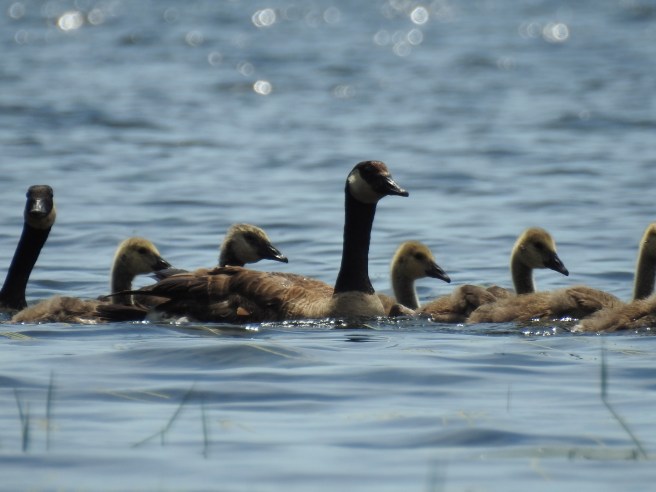
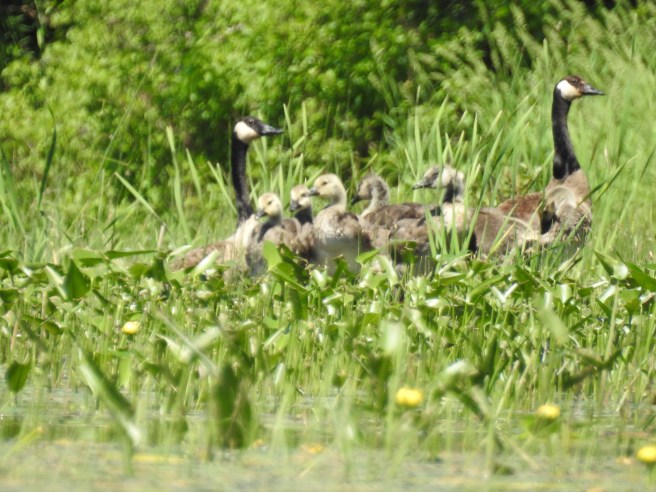
All of these insects are a necessary part of the food chain, helping to feed fish and ducks and birds and more.  There are several geese families who are doing their part to clear the bug boom.  Bernd Heinrich’s The Geese of Beaver Bog is an excellent, entertaining and educational read and I strongly recommend it if you are interested in the private lives of geese.  Heinrich was foster parent to a goose that he named Peep, and from this relationship he gained amazing access to the inner lives of geese.

Here is a bit more about the book from the publisher’s website: In The Geese of Beaver Bog, Heinrich takes his readers through mud, icy waters, and overgrown sedge hummocks to unravel the mysteries behind heated battles, suspicious nest raids, jealous outbursts, and more. With deft insight and infectious good humor, he sheds light on how geese live and why they behave as they do. Far from staid or predictable, the lives of geese are packed with adventure and full of surprises. Illustrated throughout with Heinrich’s trademark sketches and featuring beautiful four-color photographs, The Geese of Beaver Bog is part love story, part science experiment, and wholly delightful.


A flicker of wings

“The very least you can do in your life is to figure out what you hope for. The most you can do is live inside that hope, running down its hallways, touching the walls on both sides. 

From Barbara Kingsolver’s Animal Dreams

A flicker of wings in sunlight drew my attention to a branch fifteen feet off the ground.  For ten or fifteen minutes I pointed my camera up, up, up and shot this butterfly from different angles, zooming in a bit, and then further still.   I believe this is a red-spotted purple (Limenitis arthemis), though I welcome correction.  I am not typically drawn to photographing insects, primarily because at some absolutely mysterious point in my life I developed an irrational fear of having small birds and bugs zoom toward me. I suppose it is the lack of control that I dislike.  Shocking, right?

I have held this fear (and developed Ninja-like reflexes for hummingbird-ducking and the like) for at least a decade.  Hard to fight what you can’t see though: two summers ago a wasp stung my breastbone and for an entire night I felt like someone was holding a burning cigar to my flesh.  I spent a long night holding an ice pack on my chest. The Great Stinging occurred at China Lake, where my maternal relatives have had a family camp for nearly a century (and where hubby and I owned a camp for a few years, because really what better way to lose money then to quickly buy and sell real estate.  But I digress).

I’m sure that night was memorable for the neighbors who were out at their campfire.  One moment they were enjoying a fairly routine evening, and the moment next Amanda is yelling and ripping her t-shirt off.  Thank goodness I was already headed toward my grandmother’s camp when this occurred, as she took care of me with her usual intensity and grace.

Unlike the demon wasp that descended upon me sight-unseen and nearly murdered me, I can see the hummingbirds and dragonflies coming.  (Actually, the wasp was in my shirt, I think, so I’m not sure there was so much descending going on as there was lurking and whatnot.)  Moreover, they aren’t likely to cause me the type of harm that requires steady application of ice for hours upon hours.  But still I crouch and cower.  My sister has seen this.  Our friends down the road have seen this. I own it.  It’s the least of my flaws, really.  Just this evening I had my husband choking on his dinner while I did the crouch-and-cower on the back deck.

Anyway, when it comes to insects, I suppose I am particularly interested in butterflies thanks to Barbara Kingsolver’s 2012 novel Flight Behavior.    I listened to her read this novel in the spring of 2013 while I drove to Presque Isle and back for work.  Her voice is thick and sweet and her tone is calm and her prose is exceptional.  I have read nothing of hers that I haven’t liked, yet it seems that this is one of her finest.  Kingsolver’s website describes the novel as “a heady exploration of climate change, along with media exploitation and political opportunism that lie at the root of what may be our most urgent modern dilemma.”  Go to http://www.kingsolver.com FMI.  Much more simply, the book is about a woman and butterflies, and it is absolutely worth reading.


In my backyard

DSCN2939

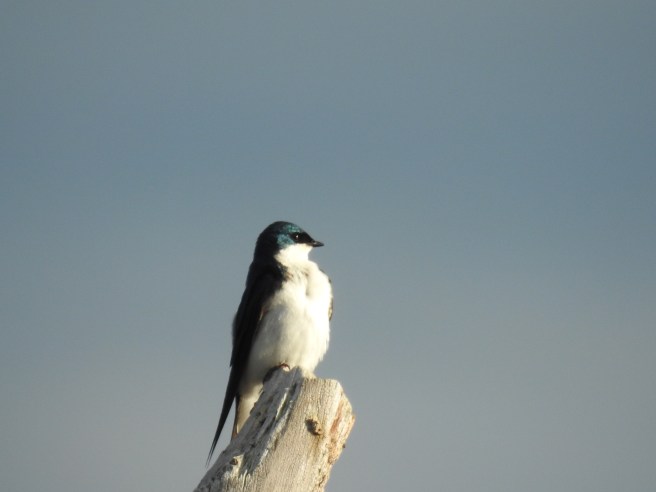
Tree swallow at sunset and grackle on a miniature breakwater.  Several families of geese – hard to photograph because they remain tucked in with the aquatic plants.  They spend the day grazing, paddling, resting.  A chirping sparrow having dinner – who doesn’t love an ant? And catbird in the magnolia.  An abundance of beauty to capture in digital images.

Today was a day of blue skies and full sun.  We are glad to hide from the world on the weekends, although we are often thinking of the family members and friends who we cherish most.  Summer is busy and the days go past in a blur of boats on water and children running and dogs forever on the wrong side of the door.  But the ones we love – living and dead – walk with us minute by minute, if we hold them in our hearts.

Water-lilies and pond weed (Or, Is That a Giraffe in Your Lake?)

On Wednesday night this week I spent two hours in a high school biology lab learning to identify invasive milfoil.  Yes, this was as dull as it sounds.  And also vitally important. Maine depends on healthy lakes for a healthy economy, and native plants and animals depend on healthy lakes for their lives.

The instructors mentioned in passing that lakes in other states are so thoroughly infested with invasive (non-native) aquatic plants that the people there have given up on trying to prevent infestations – because they have already lost this battle – and instead they MOW – yes, I said mow – their lakes, and take similar startling measures to cope with the fact that plants that do not belong in our ecosystem have nonetheless made their way here.  So what?  Well, non-native species of plants and animals do not have natural predators, which means they can go wild, grow wild, run amok, overrun, overtake and choke out the life of native species.  (This is a gross oversimplification but I’m only a citizen scientist, after all, and besides I bet your eyes glazed over three sentences ago.)

Thursday morning, armed with scant knowledge of how to identify the type of milfoil that has taken root in at least one part of Annabessacook Lake, I trotted myself down to the water, ready to look for trouble.  Okay, who am I kidding?  The sun was out and the water was calm and I was itching to see what I could find through the lens of my Nikon.  Happily for my budding efforts at learning to distinguish invasive milfoil from native look-a-likes – or the bad plants from the good plants – the water was clear to a depth of four feet.

I’ve attached some of my photos.  The startling giraffe-neck looking thing is the root system for some of the many lily pads that camp out in my muck.