Osprey nestlings

This slideshow requires JavaScript.

It is late, and I should be sleeping, but really some things must be done to keep one’s soul from getting too ragged.  So I’m sitting at my desk with the lights off to keep the bugs out, since they manage to work through the screens so that they can dance on my computer screen.  I have opened the window that is closest to the lake side of the house quite intentionally – I want to hear what is happening.  Loons are calling to each other intermittently, and once again I promise myself that as soon as I find those extra fifteen minutes in a day I will commit to memory the meaning of each call.

I wonder about the loon I watched this morning.  Is she back on her nest?  It was while I was watching that loon this morning that I captured the pictures of the osprey feeding its young.  Take a close look – you’ll see nestlings with their tongues reaching for more, more more food from the adult who brought home the morning meal.  I’ve provided the photos in the order they were taken.  The juvenile appear to be listening for the adult to return:  note the cocking of the head to the side, and then the open beak, which was in fact the juvenile calling out for the parent (or so I surmise).

Gavia Immer’s Morning Paddle

A beautiful hour and a half on the lake this morning.  Sun, clear water, and this darling, the common loon, who after an hour of not budging an inch from what must be her nest, slipped into the water and paddle vigorously past me and out toward open water.  The scientific name for the common loon – Gavia immer – strikes me as quite a fitting mouthful of fancy-sounding-ness for this beautiful bird.

Ondatra zibethicus (Or, Mr. Muskrat)

This slideshow requires JavaScript.

Each day is an opportunity to learn something – about yourself, or the world, or somebody else – but really these are all one and they same, aren’t they?  On the lake, I listen and I watch and I wait.  I’m learning to hear with my heart, and to piece together the puzzle of daily interaction that happens in this amazing ecosystem.

Twice this evening I was drawn out of the house and down to the water’s edge by a desire to understand why our resident loon pair was being so vocal.  I found no immediate or obvious source of distress.  Typically certain loon calls indicate a circling bird of prey, but I saw nothing of the sort on either trip down to the water.  My first trip down was brief – twenty minutes that passed as quickly as a single breath.  (You know you are meant to do something when you have mosquitos in your ear, weird moths all over your body, an ant dragging a spider carcass across your shoulder, sun in your eyes, painfully-full bladder, husband tapping his toes, dogs neglected….and still you can spend hours at it and feel like you have only just begun.)

On my second trip down I had an entire hour to myself.  What joy!  I quickly paddled across the inlet and around “Small Island,” which is privately owned and little used.  Small Island is the location of the osprey nest that I have been watching for several months.  On the back side of this island there are several “Tiny Islands” – owned by none other than all creatures great and small.  I’ve known for several weeks now that the animal I had taken to be a beaver (I never claimed to be an animal identification expert) lived among the shallows of this area of the lake.  While I was busy shooting ducks and birds, a splash in the water gave away this critter’s presence.  I was so excited to have an opportunity to try to capture some shots of this speedy brown swimmer – who as it turns out is a muskrat, not a beaver.

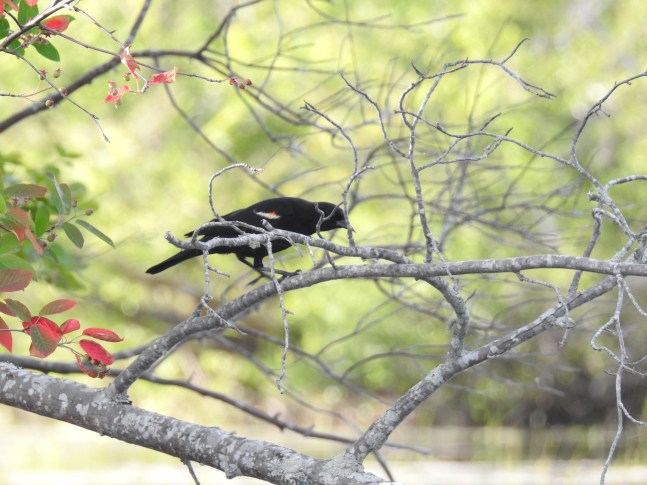
I saw him (her?) disappear under a bank, so I decided to at least photograph the spot where he disappeared.  When several red-winged blackbirds glided to a near-by branch with red leaves I decided I’d capture a few shots, since the red on the leaves and the red on the wings was impossible to ignore.
DSCN2946.JPG

To my great surprise, the muskrat decided he’d finally seen enough of me and my blue kayak to know I was not going to eat him, so out he swam from his hiding spot.  He shimmied right back onto this log and commenced to chew on his branch.  After several minutes he did a diver’s jump and flop into the water – what startled him? – and disappeared.  How satisfying to have this little fellow decide I’m not such a bother after all.

 

Go down to the water’s edge

This slideshow requires JavaScript.

In one hour tonight I saw a heron come for dinner, a loon pair preening, an osprey returning to its nest.  Very blessed to call this spot home.

Early morning pink, mid-day gulp

This is what my backyard looked like at 4:45 this morning.  Although I would have preferred to stay in a state of half-sleep, I dashed back inside for my camera.  Within moments the scene had changed and the pink was gone.  So glad my sweet Jessie girl had to greet the morning on the early side of things today.

It is mid-day now, and the early clouds have not burned off, but that makes today a perfect day for puttering and poking away at projects that need tending.  In the midst of such puttering I decided to walk down to the lake to grab an old towel that I’d left sitting there for nearly a month.

When I got within twenty feet of the water the smell of the lake – a smell that I’m still working to put into words for you – hit me in the gut and I was amazed to find myself involuntarily taking a lung-filling gulp of that air.  Olfactory memory is an amazing thing – a simple smell triggering old memories and emotions – for better and sometimes worse.  For me the smell of a Maine lake in the summer is a good thing – family, love, safety, childhood.  All of this filled my lungs and my heart this afternoon, and for a few minutes my clenched jaw muscles relaxed and my shallow breathing was replaced with a sweet deep breath.

The smell of the lake drew my attention away from the dirty towel I’d gone to retrieve and out to the water itself, which was another fine bit of photo-taking luck today, since the loon I’m trying to photograph was floating in the lily pads.  I have not had much luck getting good shots of the loons when they are on open water, so I sprinted back to the house for my camera and tried to capture the loon in the lilies.

This slideshow requires JavaScript.


Adventure at dusk

As my nearly three year old niece would say, “my running away.”  I slipped off from hubby and pups to catch the last hour of sun.  With a breeze and fishermen making my inlet an imperfect location for shooting (and relaxing), I headed to the Small Island (as opposed to the Big Island, apparently) that is home to an osprey nest and is nearby this fallen tree that I decided would be a great place to spend an afternoon.  Soon, maybe, I will paddle out there for half a day and rejoice in the beauty of sun, wood, bird poop…..

Meal time

Maine birds eating
Meal time

Eastern Phoebes have made their nest under our back deck.  I snuck a peek in their nest (using my camera on a tilt) and from what I could see (I didn’t want to get too close) there are no eggs.  Regardless, they remain committed to this nest, so I will continue to watch with interest.

DSCN2425

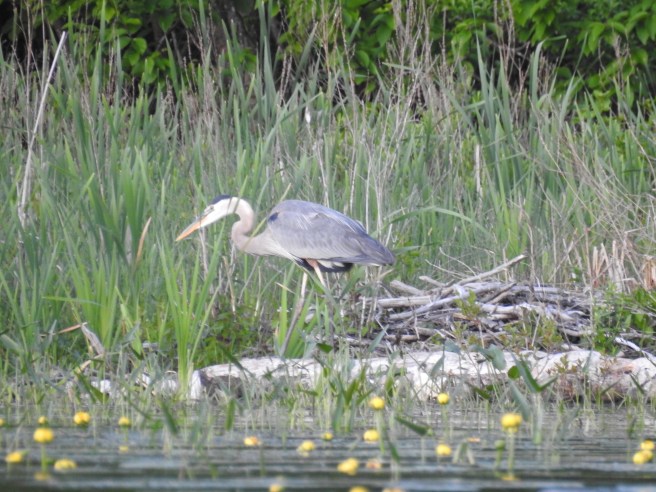
This Great Blue Heron was perched on what I think is a beaver lodge (or the start of one) located on our shoreline.  I didn’t see him (her?) until I paddled about 50 feet out from shore.  Until this spring I had never seen these birds and now I know that at least three make our inlet a routine stop for meals.  I don’t know yet where they might be nesting.  Perhaps on one of the many nearby lakes.  If you have a special interest in these birds check out the Heron Observation Network of Maine.

DSCN1337

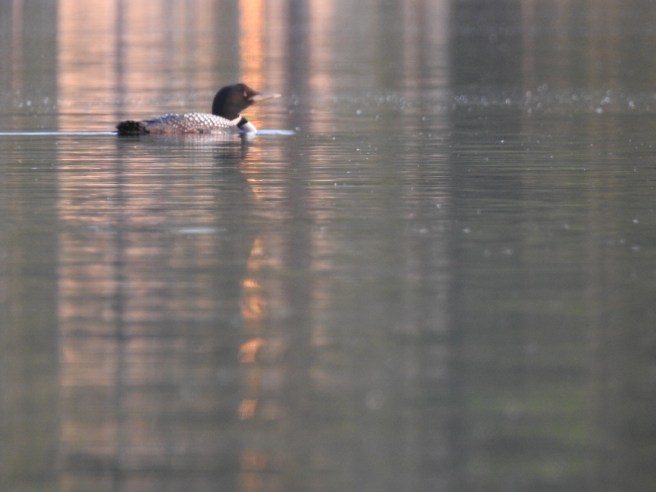
And though this may be merely a common loon, I will never tire of watching it paddle my lake.  Did you know that Mainers have been counting loons for over three decades?  This year’s annual loon count will be July 16th.  If you are interested in participating check out The Maine Loon Project  with Maine Audubon.


Egg laying


This slideshow requires JavaScript.

This snapping turtled climbed out of Annabessacook Lake, traveled 250+ feet up slopped, wooded terrain, clambered over a farmer’s rock wall, then hiked another 75+ feet to our septic field, where she has spent the past four hours in the rain laying her eggs.  I don’t have the heart to tell her that skunks, crows, raccoons and probably a few other creatures I haven’t even thought of will likely have gobbled up her hard work by noon tomorrow.  We’ve seen this happen for several summers now.  A few seasons ago some eggs managed to hatch, but the babies didn’t make it back to the lake, I’m afraid.

Ever seen a turtle crossing the road and wondered if it will make it to the other side?  You aren’t the only one.  For information on several breeds of rare turtles in Maine, as well as turtles and road crossing issues, check out Inland Fisheries and Wildlife’s Factsheet.

Dock with a view

This mallard has been on our dock and in our front yard for the past few weeks.  Sometimes birds are not as familiar and easy to identify, which is part of what makes it fun to share space with them.  Yesterday my friend at work had a female scarlet tanager in her yard.  She was able to identify the bird using Backyard Bird Identifier, a fun and easy to use search tool offered for free by National Geographic.

I remember spending at least one summer as a girl (ten or eleven years old, maybe) climbing onto our garage roof with my best friend to watch the bird at the neighbor’s feeder.  I do not recall whether we had binoculars or bird books, and we certainly didn’t have mobile bird identifier apps, but we had one heck of a good time.

Too close for comfort


Two nights ago my husband said coyotes woke him out of a sound sleep sometime before dawn.  A conversation later in the day with our neighbor confirmed that at about 3:30 am on Memorial Day the field on the opposite side of our private road had at least several coyotes in it.  And last night hubby’s sleep was somewhat interrupted by “my owl friend.”  By this he means the owl (surely there is more than one, no?) that I was hoping to photograph several nights ago on a sunset paddle along our waterfront.  We are both terribly light sleepers, in truth, and we wouldn’t trade our slice of heaven for anything, rowdy owls notwithstanding.  (Okay, maybe we would trade it for something, but let’s not quibble over my use of hyperbole.)

Last night  I watched while a rusty blackbird (Euphagus carolinus) landed on what appeared to be an osprey’s head.  (I was counting on my camera to tell me the truth once I uploaded photos at home.)  There was a slight breeze on the lake and so my kayak was bobbing just enough in the waves to make shooting hard.  I quickly paddled backwards into a small grove of trees to anchor myself and spent about 90 seconds watching this small bird drama unfold.

The osprey was a good sport about this small indignity, although I believe her expression post-blackbird gives us a sense of how she really felt.  (Thanks to  Bernd Heinrich – nature writer and scientist – for making it okay to anthropomorphize.  I can’t spell it or pronounce it but I know what it means, thanks chiefly to Bernd’s honest and tireless defense of attributing human behavior and emotions to other animals).  And even better was the confused expression on the face of the juvenile osprey.

Annabessacook Lake

DSCN1747

Summer seems to have arrived Saturday, judging by temperature readings in the high 80s to the lows 90 in Central Maine.  Across the state, Mainers who were fortunate enough to have some or all of the weekend off from work jumped to put in their gardens (we enjoyed a quick stop at Longfellows Greenhouse in Manchester), or packed up their gear and headed out on camping trips.  (Did you know that in addition to dozens of great private campgrounds, Maine’s state parks and public lands offer memorable camping opportunities?  Check out Camping in Maine’s State Parks FMI.)

Sunday’s weather was cool and cloudy, and by the evening the temperature had dropped to the mid-50s.  I wondered about the campers at nearby AugustaWest Campground and Beaver Brook Campground and hoped that they had brought warm clothing or extra blankets.

Today’s forecast included enough steady rain that many Memorial Day parades were canceled, though by early afternoon the sun burned away the clouds by about half, certainly enough to get outside to enjoy the last stretch of a long weekend.

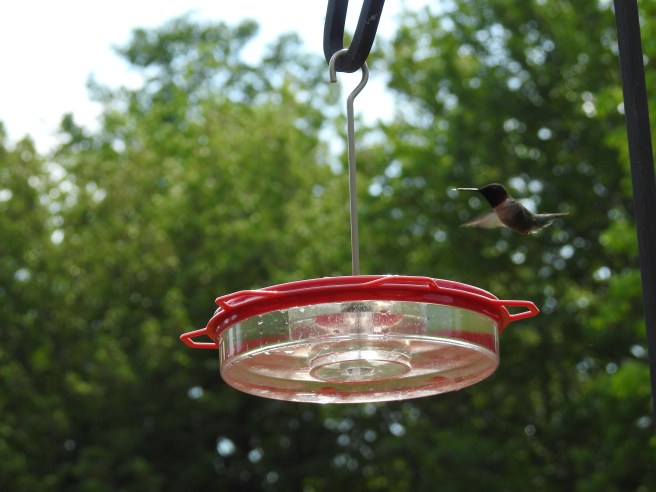
Summer in Maine goes so quickly.  Already the black flies are gone and the mosquitos have come in droves.  Trees have leafed out.  Several days ago the dragonflies started zigging around our yard, gobbling up bugs.  And today we finally got out act together enough to repair a damaged hummingbird feeder (we are nothing if not frugal) and fill it with sugar and water (the pre-made mix is not necessary, and in fact the red dye in it is said to be dangerous).   How lucky and lovely to trade such a simple potion for such fine views.

DSCN1771