Mother Nature Abounds

Monday afternoon I was delighted to find a great horned owl perched high in the limbs of a pine tree about 200 feet from my back deck.  I had followed a very specific sound into the woods, hoping to identify the animal responsible for the intermittent shrieking that has been piercing our sleep for several weeks.  I’m not sure I found the culprit, but I did find this amazing owl.  I have never seen a great horned owl so I was very excited.  I didn’t have a great deal of time to stay and take pictures, and I didn’t want to bother the owl anyhow, so I did my best and the result is the top row of photos.

Tuesday afternoon I went looking for this same owl and found a juvenile great horned owl.  The juvenile was perched in a tree that overlooks the abandoned stump that was, I believe, the place where my murder mystery/kayak attack began a few weeks ago.  (See I Swear I’m Not Making This Up if you need to come up to speed.)  So now I’m wondering if the predator in that crazy showdown was an owl and the prey was in fact a family of raccoons that nested in the top of the stump (which is more of a 12 feet broken tree than a stump, but you get the idea).  I think I may be on to something here.

Seeing the owls would have been enough to last me for the entire month.  (Though of course I’m greedy and already hoping to see them again, or at least for my husband to see them.)  But Mother Nature is really outdoing herself at the moment.  This morning I saw a doe and two fawns.  No camera on hand.  I also saw a little brown rabbit twice, but again I was without a camera.   Monday and Tuesday I saw a lone turkey (a female, so a hen) and her baby (a chick).  Wondering where the other chicks went.  Guess I might know.  The first time I saw the mama and baby turkey I scared them when I opened my always-stuckish garage door; the second time I didn’t have my camera.

Did my milfoiling yesterday and today.  Loads of fun, that.  Thankfully my milfoil sector has been changed from one (nearly free of green stuff growing) across the lake to the sector where I live, which is so full of green stuff growing you can hardly paddle through it.  I guess the only reason I’m thankful for the switch (aside from not needing to inconvenience my husband, who would have had to motorboat me to the other sector) is that while I’m paddling around mumbling “whorled, feathered, whorled, feathered” to remind myself of the key features of variable-leaf milfoil, I can also take note of the osprey adult clutching a fish in its talons and flying back to screaming nestlings, the great blue heron poking about for a meal, the swallows swooping low for dragonflies, the loon calls echoing in from further down the lake…

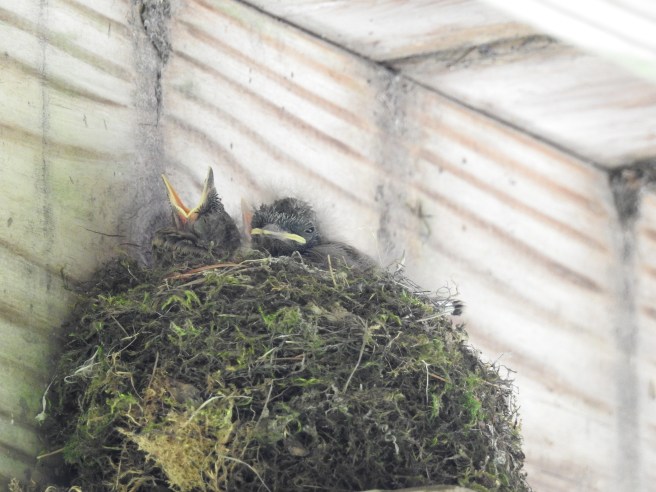
I also have to make time to water the flowers that I insist grow on the front and side of my house.  I find myself doing this in the late afternoon most days, after I have given up on rain coming through in the night.  Watering these flowers requires a fair amount of watering-can-lugging, and so I make it into an exercise task, this lugging, since I never do seem to exercise as much as I’d like.  My lugging route takes me past the back deck, which means I simply turn my head to the left and look for baby phoebe beaks in the nest.  Finally – three beaks!

DSCN5314

I think these birds are way too hot under the deck. I’ve considered a fan, or a small wading pool, but decided I should leave well enough alone and let their parents handle the care and feeding of hot birds.  Observant readers  will quickly note that my concern for these hot birds is a minor obsession (see Dog bowl bird bath).
DSCN5307

Whenever I peer through the space between the deck boards to check on these babies all I see is heaving sides – birds trying to breath through the July heat.

And July’s heat has arrived.  June’s Strawberry Moon has come and gone.  The 4th of July is behind us. My neighbor’s garden is going gangbusters, so I’m looking forward to grilling zucchini and summer squash soon.  (Okay, my husband will be grilling.  I’ll be eating.)  Sort of like that phoebe on the left. That gal is always beak open looking for a snack.

The farm stand down the road from us is boasting two cabbages and some garlic.  Yes, two cabbages.  Cut them some slack – it’s a hobby stand at best and besides, I certainly haven’t grown a cabbage yet.  (In fact, I’m not even trying.  But I’m sure hoping that the pumpkin seedling I bought last month does amazing things.)

Wildflowers keep changing in the field beyond the farm stand.  We’ve gone from a wave of lupines to a wave of Rudbeckia hirta, or black-eyed susan’s.   Rasberries are ripening.  And old axes have been sunk into deadwood to rest.

Yes, folks – summer in Maine has arrived.  Get some while it lasts!


Great Horned Owl

Monday I followed bird sounds into my woods and found a Great Horned Owl.  Tuesday I went back to look for this bird again and found a juvenile.  More to come….

The Fresh Air Fund

DSCN5168
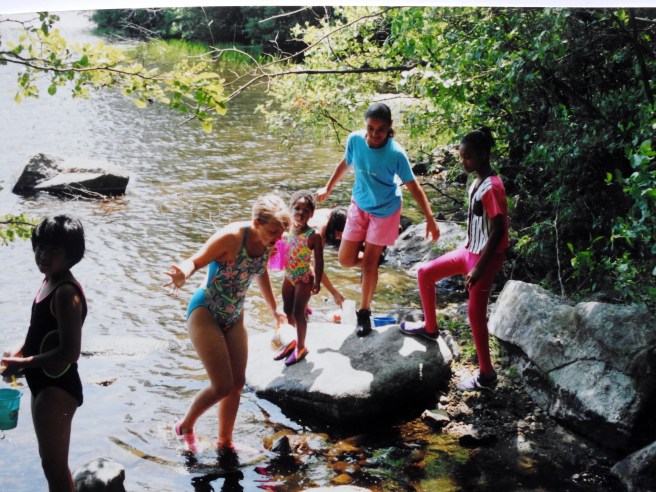
I am pictured here with my sister (left), two Fresh Air Fund children (right) and two neighbors (front left and center front).

In the summer of 1877, a  particularly virulent tuberculosis epidemic swept through New York City’s tenement buildings.  Mycobacterium tuberculosis spread rapidly through the sputum released in the coughs and sneezes of the sick, most of whom were children.

That same summer, Willard Parsons was a young clergyman whose first assignment after graduation from the Union Theological Seminar in New York was to minister to a rural Pennsylvania community located a few miles west of the NY-PA border.

At the time of this epidemic, fresh air was considered a cure for many respiratory ailments.  (Consider that Maine became a state in 1820, the Civil War ended in 1865, x-rays were discovered in 1895 and penicillin was discovered in 1928.)  As the story goes, Parsons was on a horseback ride in the countryside when he realized that his parishioners could offer NYC’s sick children exactly what the doctor ordered – fresh air.  From the pulpit of the Sherman Mission Chapel, Parsons urged his congregation to open their homes and give these children the opportunity to experience the wide open beauty of a countryside in the full bloom of summer.

That summer nine children left New York City and stayed with families in Sherman, Pennsylvania. Today, over 1.8 million children have stepped off hot city pavement and onto buses headed for volunteer families on the East Coast and Southern Canada. (There is also a Fresh Air Fund camp 60 miles north of NYC in the Town of Fishkill, NY.)

Roughly 25 years ago, my parents opened our home to a Fresh Air Fund child.  Our neighbors, who were an extended family in practice (and remain so in my heart today) did the same.  Blond hair, blue eyes, black hair, brown eyes.  Families are made from love, not biology.  When this picture was taken in the early 1990s, both my parents and my “next-door parents” had already opened their hearts and homes to non-biological children.  For years people found the most terribly intrusive and awkward ways of asking about this.  How sad, even if they were just being curious.  I hope it isn’t the same today for rainbow families – and I mean any damn kind of rainbow that makes a family. Missing from the picture is my older brother with his light red hair; older brothers do not typically run around with a gaggle of girls.)

For several years both my nuclear family and my next door family invited Fresh Air Fund children into our homes.  My Family Next Door owned a piece of heaven on a quiet pond an hour away, and because they were brave and kind in equal parts they would take all of us to camp to swim, canoe, catch crayfish and sail.

DSCN5167
You might note that I appear to be bossing the other children around.  For anyone who knows me this will not be a surprise.  My sister stands in the shadow on the left, probably wondering how to make a quick get away.  Missing from the photo is the oldest of my two Next Door Sisters.  She probably had already made a run for it.

I remember the great hesitation with which our host child approached camping.  I also distinctly recall her swatting something edible (strawberry? pea pod?) from the hand of one of the Maine natives in our group, yelling “Cucka” for emphasis.  Not an unreasonable reaction at all, if you consider her viewpoint.

For most of us, exposure to sunshine and fresh air provides significant benefits to our mental and physical health.  Additionally, numerous scientific studies link urban living to higher stress levels.  (I can’t imagine why.)  Factor in the poverty that these children live with and you can quickly see how a few weeks away from the heat and chaos of New York City would be welcome.  (But imagine the courage it takes for a young child to board a bus and head into the woods to live with strangers for a few weeks.)

The next time you enjoy a lungful of Maine’s fresh air remember how lucky you are. But know this: even if we took every vehicle off Maine’s roads we would still have air pollution problems, since wind patterns carry pollution to us from coal plants in the Midwest and the more densely populated portions of the eastern seaboard.

How to keep the air breathable for future generations?  Take a look at tips from the United States Environmental Protection Agency on how you can help curb air pollution: https://www3.epa.gov/region1/airquality/reducepollution.html

While certainly better than the air in New York City, Maine’s air quality is far from perfect. If you have respiratory ailments or care for the young, old or ill, you can check Maine’s air quality forecasts on the DEP’s Air Quality page: http://www.maine.gov/dep/air/ozone/.

Walk in the Woods

Go, walk in the quiet woods.  Hold you lover’s hand, or slip among the trees by yourself.  Put on your yoga pants and go with your best friend.  Take a child you love, and maybe another who needs to be loved, and teach them to marvel at the wonder of pine scented air and a hush that wraps around tree trunks and tickles their spines.

Wear ripped jeans and old sneakers.  Or Under Armor and LL Bean.  The trees won’t know the difference.  Just get out and go. Tired bones?  Busy day?  Not an “outdoors person?”  Hate the bugs?  Got a show to watch?  Go anyway.  Breathe deeply.

Earlier this week husband and I took our girls to Jamie’s Pond Wildlife Management Area, an 840-acre property that is publicly owned and managed by the Maine Department of Inland Fisheries and Wildlife. There is no entry fee, and the public is welcome to boat, fish, hike, bird watch and more. We “discovered” this tranquil hideaway at least five years ago and we go there perhaps a dozen times each year. We select hiking locations and times strategically, as we much prefer peace and privacy. We found that there this week, with no company on the trails expect birds singing from above and deer flies darting in from all sides. I dragged my camera along, hoping to spot the owl that I’d heard on our last visit, but no luck.

Today husband and I slipped away from our girls (we told them we had to work and that their best friend would come at noon as usual) and then we zipped to husband’s favorite haunt from the time in our lives when we lived south of the Gardiner toll booth. Bradbury State Park in Pownal, Maine is only an hour from where we live now, though it used to be ten minutes away from a condo that we called home in Freeport.  An admission fee of $4 per adult (Maine resident price) gives you access to hiking and biking trails, horseback riding trails, camping and scenic overlooks.  Bradbury, one of Maine’s five original state parks, offers over 730-acres to explore. Maine’s Department of Agriculture, Conservation and Forestry manages the park (and quite nicely, I might say, as the staff has always been friendly and helpful and the park is well-maintained.)

We took the boundary trail and reveled in the silence.  Sure, there was occasional bird song, and even still more occasional child-song, but mostly it was just us, and the trees.  Tall, tall trees stretching up the side of a 500 foot (smallish) mountain shaped by a glacier in the last ice age.  All of the steep cliffs and bluffs on Bradbury face southeast, the direction the glacier moved on its way toward the Gulf of Maine. Today’s cooler temperatures kept most of the biting insects away, and for that we were thankful. I ignore the deer flies for as long as I can but eventually start swatting at my head and the air in a futile effort to kill my tormentors. At best I manage to tangle them into my hair, while my husband dispatches deer flies using a technique that is part ninja, part ballerina, and entirely successful.

Check out Maine’s Bureau of Parks and Lands website for more information on all of the ways that you can get outside and enjoy Maine: http://www.maine.gov/dacf/parks/


Summertime fun

This slideshow requires JavaScript.

My favorite shot is the one where he is flipping onto his back and both feet are in the air.   I think that what we saw was a mix of preening, bathing and playing.  Since I spent the day playing at Popham Beach with some of my dearest loves I will leave off here for now…..

Dog bowl bird bath

Thankful for another day of blue skies and temperatures in the high 80s. We are on “staycation” so the weather suits us perfectly.  If I had to be in my office I’d be climbing the walls.

Busy day today with too many obligations away from the house.  Voluntold my husband to take me for a motorboat ride this afternoon so that we could identify the stretch of shoreline that I’ve been assigned to monitor for milfoil.  After we found the location we took a short boat ride  and ended up mesmerized by a pair of loons that were bathing and fishing.

I took over three hundred photos of the loons and need to sort through them to find the best ones.  The male of the pair (I think it was the male because he was larger) was acting like my younger dog acts when she is in a silly mood – lots of wiggling and similar joyful movement. I’m sure the loon’s behavior was typical preening and bathing but it looked for all the world like he was just goofing off.  Can’t wait to review those pictures more closely, do some research,  and share my absolutely unscientific conclusions with you in the next few days.

On my way back to the house after our ride the shadow of a wagging tail under the deck drew my attention.  Note in first and fourth photos that there is a bird on the handle of the lawn mower wagon and a shadow on the house foundation beneath.  I snagged a few photos of this new parent (the chicks are still in the nest and appear to be doing okay) and I couldn’t help but think this phoebe looks like a worn out new father.  He looked perplexed and exasperated, but really he was catching bugs.

The temperature under the deck was at least 90 degrees (I checked) and so after I finished the phoebe photo shoot I grabbed a dog bowl and filled it with fresh water, then put it on a pile of slate stacked conveniently beneath the nest.   A crude bird bath for certain, but better than nothing for the balance of the afternoon, as I had to leave and didn’t have time to do more.  Granted the phoebes are 300 feet from a lake, and I’m sure they are meeting their hydration needs somehow…..and my husband figures (probably wisely) that these birds aren’t likely to start drinking out of a shiny bowl….but the effort cost me 3 minutes and 16 ounces of water.  Drink up, hot birds.

One fell out of the eagle’s nest

DSCN4691DSCN4700DSCN4733

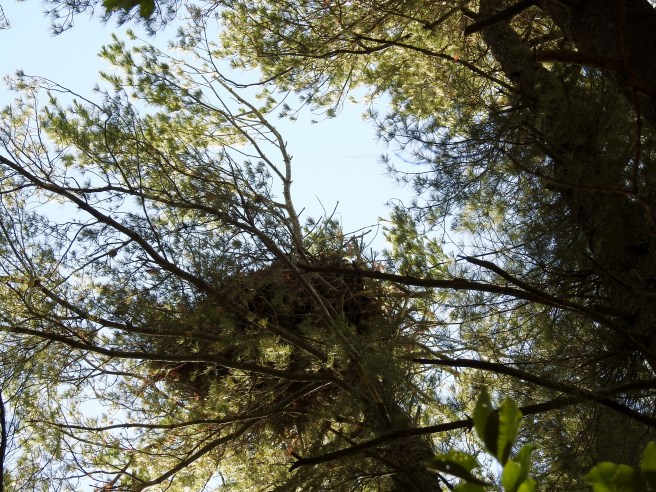
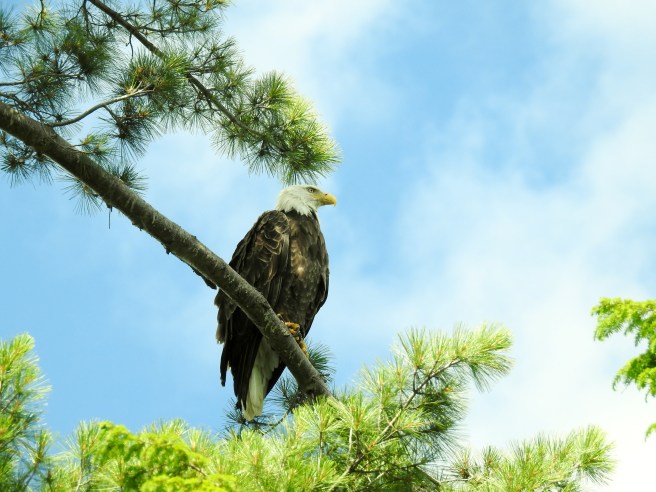
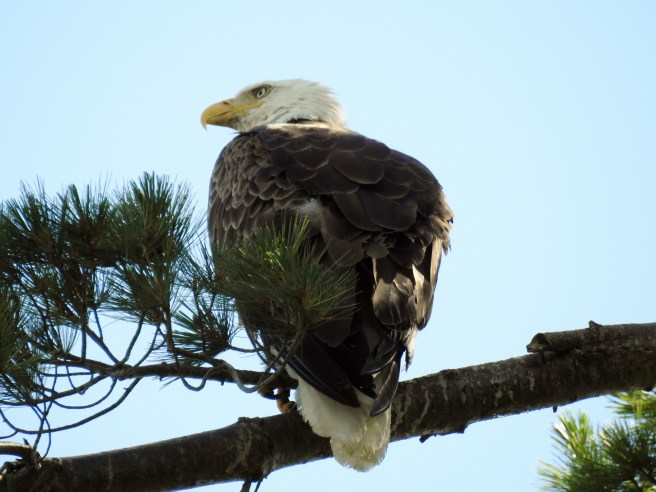
A pair of bald eagles nesting on the western shore of China Lake had a terribly sad week.  Friends of ours who live near this eagle nest found an eaglet in the middle of their camp road earlier this week.  The game warden was called and the eaglet was taken to Avian Haven, a wild bird rehabilitation center in Freedom.  We visited our friends yesterday and I was able to photograph the nest as well as the female perched in a tree.  The male was circling with the airplanes so my shot of him is not as clear:

DSCN4743It has been very windy for the past week and the game warden suspects that the eaglet was blown from the nest, perhaps while flapping his wings and lifting up out of the nest (pre-flight practice).
Do you know what to do if you find lost or injured wildlife?  Maine’s IFW has a page devoted to “Wildlife Rehabilitation” and on that page you can find a list of wildlife rehabilitators licensed by IF&W to accept wild animals for rehabilitation purposes. Here’s the link:  http://www.maine.gov/ifw/wildlife/human/rehab.html


Lean Times

Sleep came late last night, after fireworks and thunderstorms finally drove me into the basement with my sweet old lady Jessie (on the left).

100_0108

And morning came too soon thereafter, since my little lady needed to get up with the sun to empty her bladder.

An hour later I tried out my legs and my lungs on a slow morning run.  Last night’s rain still sat heavy on the forest canopy, and the wind that was with us all day started early, so I ran through mini-rain showers with the deer flies cheering me on with their “teeth” (more like blades, actually).

I cut off the main trial to follow the brook path for a quarter of a mile and was glad to see that we’d had enough rain in the night to quicken the flow of water.  I am humbled by the power of moving water to sooth me.  Research in the field of neuroscience and similar fields of study has consistently documented a connection between proximity to water and overall well-being.  (Marine biologist Wallace J. Nichols explores this concept in his 2014 book Blue Mind; the book has received solid reviews and is probably worth reading this summer.)

I followed up my run with  errands and visits, and it was mid-afternoon before I was back in my yard with my eyes to the sky.  We hadn’t been outside long before osprey overhead  caught my attention. I watched with interest and then concern as first two and then three and finally four adult osprey circled our yard and the adjacent fields, as well as several thousand feet of waterfront, for over four hours searching for a meal.  I am guessing that the wind on the lake made it difficult to see the fish.  I’m not sure why the rodents in the fields were so hard to find today.  I do know that the song birds that nest in our woods had a long afternoon of nest defending.

The osprey still have nestlings and I wonder if they’ve had a meal today.

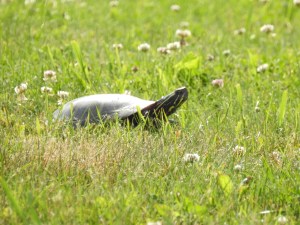
Eventually I turned my attention from the sky above to the ground below. Earlier in the afternoon my younger dog had nearly lost her marbles because a painted turtle had scooted under the deck to use the loose soil for egg laying.

DSCN4389

In addition to being a turtle sanctuary, the back deck is also the location of a phoebe nest.  Finally today patient mama phoebe welcomed a clutch of babies today.  (Her first nest was raided before the eggs hatched.)

This time around there were four eggs, though only three have hatched.  I was able to see their tiny beaks by peering through the space between two boards.  (Last week I crammed a bit of corn husk in between two boards to give me a quick visual cue for where to look.)   I wish I could capture this on camera for you but it cannot be done in any responsible way.  I will be eager to check on them in the morning.

I Swear I’m Not Making This Up

Picking up where we left off yesterday….

So mid-morning yesterday I am in my backyard with my oldest dog, letting her pretend to pee for the third time in an hour.  Really she wants to sneak behind the woodpile and through the raspberry bramble to the drainage pipe outlet.  (As mentioned in Downy in the forest, one of my dogs has been interested in culvert inspection since an early age.)

So off we are headed for the PVC pipe (PVC not to be confused with premature ventricular contractions, incidentally) and suddenly my brain is registering a cat fight in the woods.  Only this cat fight includes more than hissing and high-pitched screeching: one of the participants is growling savagely – as though saving its life or ending another life is already a foregone conclusion and the growling is some sort of awful finishing blow.

I look toward the sound and see an animal about the size of a ten pound dog  climb down from one of these trees and amble away as quickly as possible.  (Its movement reminded me of the several times I’ve had the opportunity to watch a porcupine move through this same patch of woods.)

DSCN4449

I pick up my dog and jog her back to the house, then turn and run back towards the half of our lot that is wooded – this is where the sounds are coming from.  Before entering the trail that leads from lawn to lake I grab my husband’s pitchfork, which he has leaned up against a tree trunk at the head of the trail.  (Pitchfork, you ask?  I’ll tell you another day.)

Pitchfork in hand, I am running over slippery dirt and roots (of the sort mentioned in Turtle in the fast lane) toward the sound of killing. The terrible sounds have moved into the thicket of underbrush that covers our shoreline, so I cannot easily move closer to the sound, though I try.  I am stopped by a huge pine that is difficult to get over or under, and I am further hampered by the slip on clogs I have on my feet.  I also have a healthy dose of “You idiot STOP moving in the direction of those animals” racing through my head.  This is smart for two reasons:  (1) Whatever is being attacked is by now either dead or very badly hurt and would almost certainly be better off dead, and (2) assuming neither my neighbor’s dog nor somebody’s infant is being killed, I really should mind my business because animals eat each other every day.

Yet still I find myself determined to understand what I am hearing, so I grab my kayak, abandon the pitchfork, and launch myself into the lake.

DSCN4433I quickly paddle close to shore in the direction that the sounds have been coming from. I have no plan.  I expect at best to see something awful from a distance.  What I do not expect is to smack a an already frightened and/or angry creature on the head.  But this must be what happened, because within seconds of being in the water my arm muscles tell my brain there is an odd weight on the left hand side of my kayak paddle; my ears tell my brain something is screaming at me; and my eyes tell me that a really angry rodent is literally clinging with both paws to my paddle, teeth bared, screaming mad at the world.

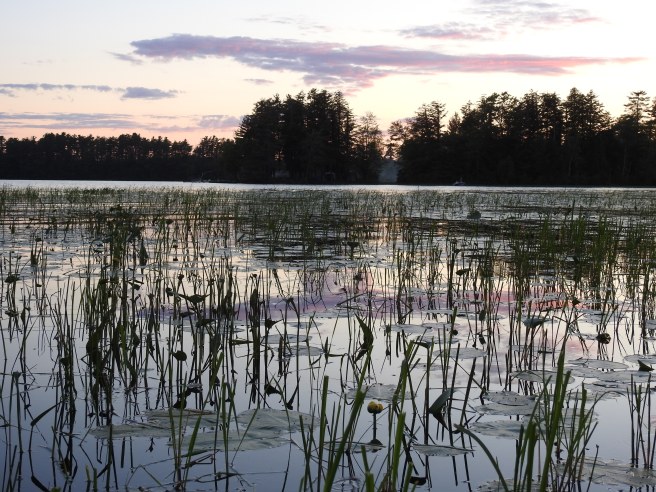
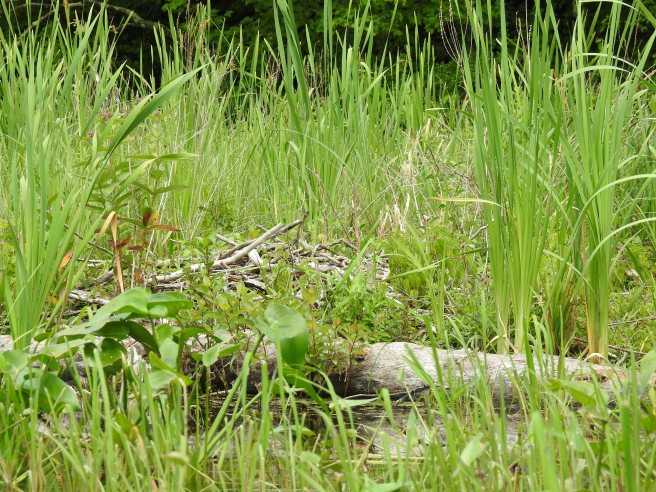
I am concerned that this furious creature will climb the paddle or simply jump at my face and bite me, so somehow I have the presence of mind to dunk this clinging creature back into the water.  I simply redip the paddle into the water and then keep paddling.  Thankfully he has had the presence of mind to let go.  Once I’ve moved off by a few boat lengths I turn and see that the scared little guy has swum to the log that lies at the front of the stick lodge pictured above.  He has climbed onto the log and he is hunched up and making these pathetic cries that for all the world sounded like he has lost his mother.

Twenty feet away this little creature’s twin is similarly hunkered up on a mound of cattails and marsh grass, also making the same sad crying sound.  But the second creature is much closer to the sound of the hidden skirmish, as I sit in my boat and watch him he paws and noses at an opening in the dense stand of vegetation and then disappears in the direction of his interest.

Here are some photos from trees that are located on our shore and not more then ten feet away from the lodge (or den or feeding hut) that the first creature swam back to.

Here’s the thing: I have seen muskrat on this lake from ten feet away, as noted in Ondatra zibethicus (Or, Mr. Muskrat).  These two animals did not look like muskrats – at least not to my frightened and untrained eyes.  Their coloring was too varied – though maybe wet fur and the play of light and water are throwing me.  I didn’t get a look at a tail, so that is no help.  I remember numerous small sharp teeth, not huge front teeth – so no beavers  The more I talked this through with my husband last night, and thought about the form of movement I saw on the earth, and the postures I saw on the log, and the coloring, and the shape of the face that was screaming at me, the more I want to identify these creatures as raccoons.  But why would two baby raccoons be swimming around a muskrat lodge?  And who came down from that tree?

Now, it is possible that the creature being killed was already in the dense vegetation.  Many ducks and geese have been nesting in these areas.  And though I can not describe for you here and now the full vocal range that was involved in the attack/fight/resistance, there are two occasions at least when I thought I was hearing a duck die.  (A chick or gosling or duckling, perhaps.)  And maybe the predator was winged – an owl or eagle?  And the animal running out of the tree got caught in the cross fire?

I have no idea.  I plan to spend the next few months watching and listening and looking for clues that could help put some of these pieces together.

DSCN4482

I went back out tonight to sit near the little stick house and see what I might see.  I found a lovely dusk.


Late breakfast….

DSCN4431
Great Blue Heron
DSCN4468
Little green frog

The best adventures are the kind that nearly require you to call 911.  Such was the adventure I had today.  Highlights include a battle to the death that sounded like the worst cat fight you’ve ever heard at 3:00 am, a pitchfork, and one enraged ten pound rodent CLINGING TO MY KAYAK PADDLE, teeth bared.  As one of my favorite authors, Dave Barry, would say, “I swear I’m not making this up.”

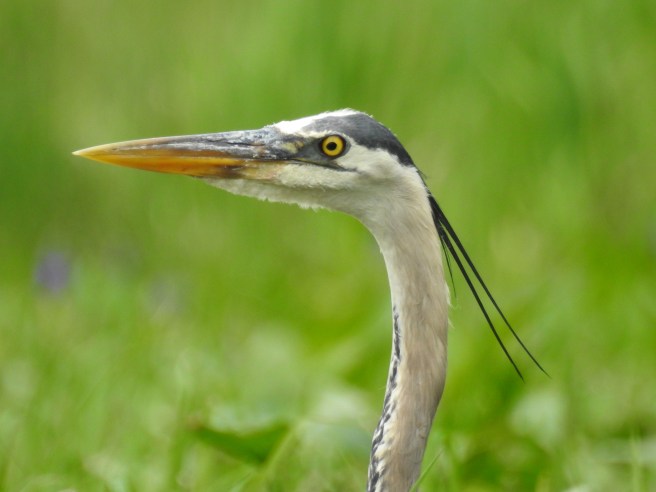
So the pictures above were taken many hours after my heart stopped pounding  hard enough to cause me significant concern.  (My heart has been on the fritz lately, but nothing too serious.)  The heron landed about twenty feet off my left shoulder while I was staring into the dense underbrush where the incident had occurred, trying like the best detective possible to piece together the facts.  The little green frog was nearly under foot on an ill-conceived but well-executed tiptoe through pucker brush looking for animal tracks in the muck to help me identify which of the creatures in my backyard got inadvertently bonked on the head with my paddle and came up ready to bite.

The story is such a good one that I am going to wait until I am actually awake to write it.  I’m also going to attach the only photos I have that give clues (or red herrings) as to what sort of animal I was dealing with.  I already talked the details through with a friend who knows Maine wildlife better than most of us ever will, and he’s putting his money on a fisher being involved.  Stayed tuned, folks.  Tomorrow night is only 24 hours away.

Summer was…

100_0677

Box fans.  Kool-Aid.  Chlorinated pools.

The top bunk.  A lake breeze fluttering the homemade curtain all night.  Listening to wavelets kiss the rocky beach.  “No digging in the clay!” –  and digging anyway.

Mosquitoes in the tent, buzzing in my ear.  Sunburns.  Crab shells by the seashore.

Green quart baskets filled with strawberries.  A garden growing corn, carrots, pumpkins, peas.

A tree cabin in the woods.  A stream conjured up from the outflow of a drainage pipe, with plans for a fish pond and flower garden.  A hammock strung between two oaks.  Bike rides. Sparklers in the backyard. I am eight, nine, ten and the summers are endless.


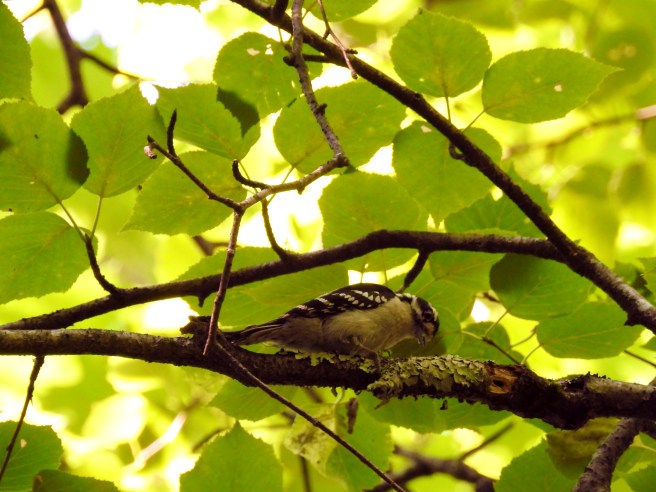
Downy in the forest

DSCN4375

Downy woodpecker searching for breakfast. Heard her (the male has red on its head and although I can’t be certain I think this is a female) while walking the dogs on one of our favorite trails this weekend.  The trail loops through the woods near the first house we lived in when we moved back to Central Maine ten years ago.  The path is wide enough for adults and children and dogs moving in both directions to pass each other without excessive chaos.  There is one cut-through, one loop out onto private property, and now one short cut I’ve made for myself.  There is also a trail that cuts away from the main loop and for a distance follow a brook.  There are no scenic vistas or anything of the sort – by all accounts these are ordinary trails.

It is the ups and downs that I’ve walked and jogged and sprinted and hobbled through that make this network of trails extra-ordinary.  It is the bend in the stream where I stood one cold November morning and somehow knew that my cousin was gone.  And it is the fallen tree across the pond’s outlet where I hunkered down to sob out the loss of my father.  It is which-rock-I’ll-never-know that ripped my husband’s ankle to shreds.  The strangers we’ve passed so many times we now count them among friends. The rock I always hide behind to pee.  The culverts my dog wants to climb through – every single time.  The deer that graced the thick woods with their presence before the clear cut.  And the views of my old house that I refuse to glimpse through the trees.

As 20th century Spanish poet Antonia Machado said, “Travelers, there is no path, paths are made by walking.” That is –  we make the path by walking.  I have walked this path through all four seasons many days a week for many years.  This was so much easier to do when I could walk out of my back door, cut through 50 feet of woods, and hit the trail.  Our move made this quick walk a brief car ride, but most days when I step onto that path I feel like I am with an old friend.  Having an old friend to return to is especially important when the path forward is so hard to see.  Learning to expect the unexpected, practicing going with the flow.  None of us really knows what is around the next bend.  Keep walking.