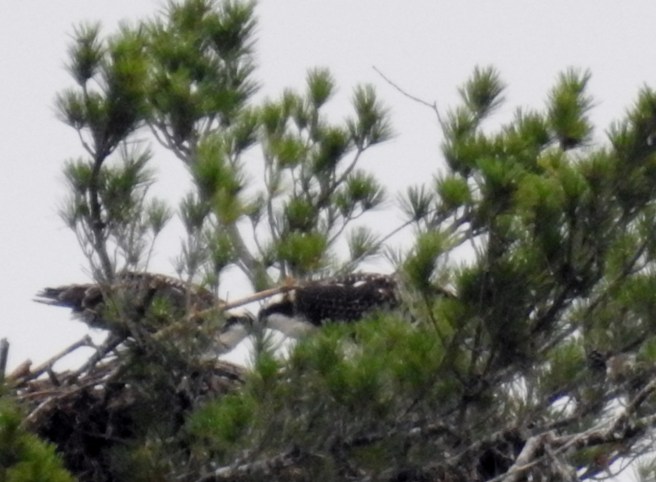
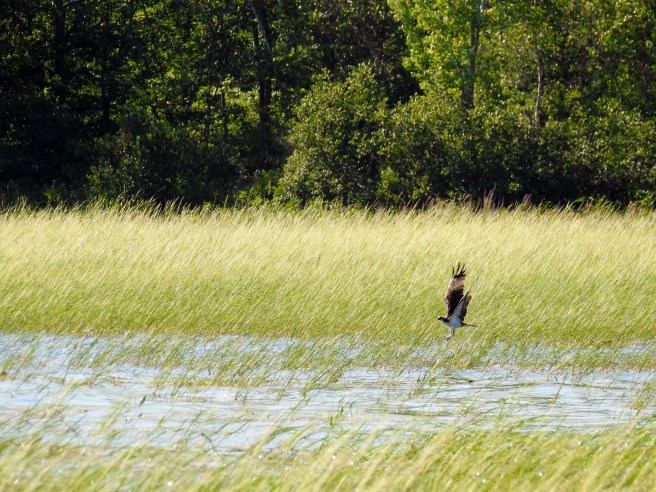
Actually, I believe that these are osprey siblings taking a bite of the same piece of food. I sat and listened and watched them for half an hour today and the bird on the right was clearly eating something, alone, while the bird on the left was making a lot of noise and fuss. Eventually the bird on the left stopped with the noise making and got involved in eating, though that seemed to lead to more frustration, since he finally flew off to a nearby tree. Shots below are a bit blurry.
Author: Amanda A. Meader
A flower, a smile, a memory
Received these lovely gladiolus from a friend today. The best kind of gift is the one you never expected. Gorgeous! The nature of Maine is seen not just in our woods and shores, but in the smiles of friends and neighbors and colleagues who reach out in kindness day in and day out. It is in the generosity of the second hand clothing shop owner who can’t make ends meet but still gives to the local youth who are so in need. It is the grocery store clerk who actually cares if my heel is healing, and the post office master who will miss seeing me once my new job takes me west out of town rather than east.
Snapped some photos tonight of the rosa rugosa growing on the side of the house. Can you smell it? Close your eyes and think of the beach. These roses remind me of my childhood home, since we had a hillside of rosa rugosa that bloomed each summer. I remember the smell of the roses and fresh cut grass – my father pushing the mower on our small bit of lawn out front. Once my mind wanders to my childhood home, it quickly expands to include the neighbor’s house – that of my second family (mentioned in The Fresh Air Fund). There was something special about those families, those houses, that short period of time (ten years, maybe?) before serious illness in each household turned our lives upside down.
I think I’ve got the history of these houses mostly right – pieced together from listening as a child. The houses were nearly identical. They’d been built for a pair of sisters after the First World War, in a quiet residential neighborhood in a small New England mill town. The trees that lined the street had not yet succumbed to Dutch Elm disease, and the depression that would cripple the mill had not yet descended on the town.
The houses cannot easily be described by reference to a particular architectural style: They were not as splendid as the soaring sea captains’ homes that run along the rises of land in towns where the rivers turned tidal. Nor were they grand colonials or pretentious federals or ostentatious Greek revivals. They were not precursors to the uninspired modular homes of today, or to the fractured ranches that were built without a sense of unity but rather separateness, floors disconnected and hallways tight and dark.
The houses were most similar, perhaps, to the ubiquitous Capes that became so popular at the end of the Second World War. They were more generous in proportion, however, with high-peeked roofs bursting boldly into the air, and spacious front porches encouraging neighbors to gather. The houses lacked the Capes’ submissive uniformity: there was no shrinking back from the road to line up with a row of identical houses, no hunching under diminutive second floor dormers.
The neighbor’s house was buttercup yellow with shutters painted the deep green of pine needles in high summer; ours a simple white with black slatted shutters. There were patiently tended flower gardens in the side yards, anxiously tended vegetable gardens in the back. Inside, the houses were not fancy, but neither were they plain. Fifteen feet of neatly trimmed grass separated each house from the sidewalk. We never minded the proximity to the road. We had a white picket fence, after all. Now the fence is gone. Our families moved away long ago. Life changes. I think it is better not to look back, though I do make my husband drive down my old street once every few years, when we are passing through to another town. Funny how things seemed so much larger when we were young.
Pretty ending
Where did the weekend go?
Lots of little frogs spending their days hopping through the leaf-litter of our mini-forest. And lots of goldfinches spending their evenings in the treetops on our waterfront.
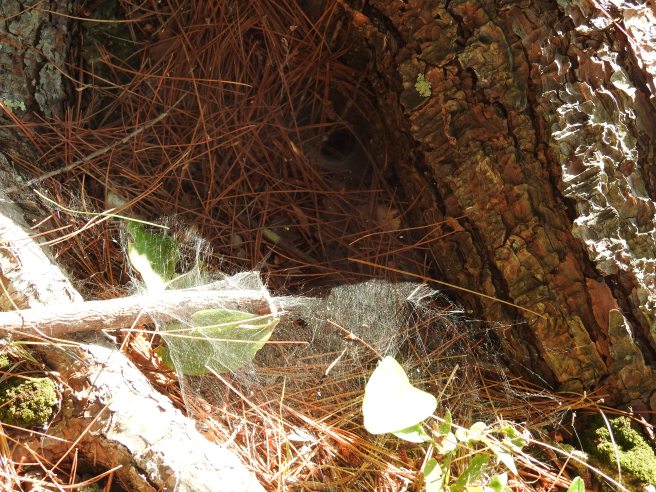
And always there are spider webs to be found, if only you look for them.
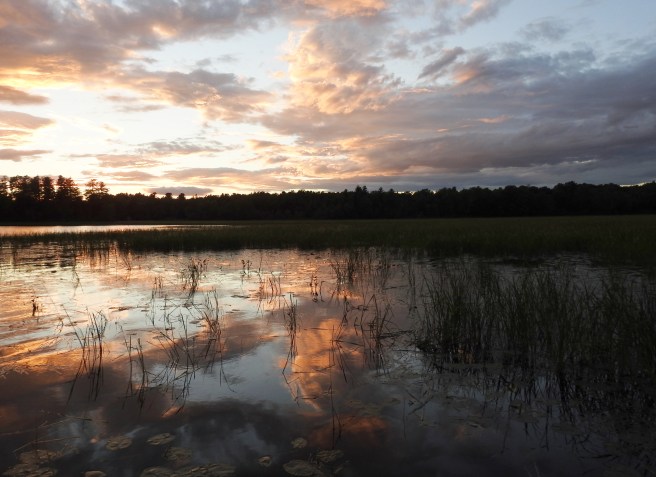
Did I mention that it was a pretty ending to the day?
Sleep peacefully and dream only sweet dreams.
It’s not a bird, it’s not a bee….

Although the days are still incredibly hot, I’ve noticed in the past week or so that once the sun sets the air cools quickly. As soon as we are able to each evening, my husband and I go around the house opening up shades that have been closed against the sun all day, hoping to flow fresh, cooling air from the lake through the stifling house. (Tonight the lake air smells of cow poop. I’ll tackle that one another day.)
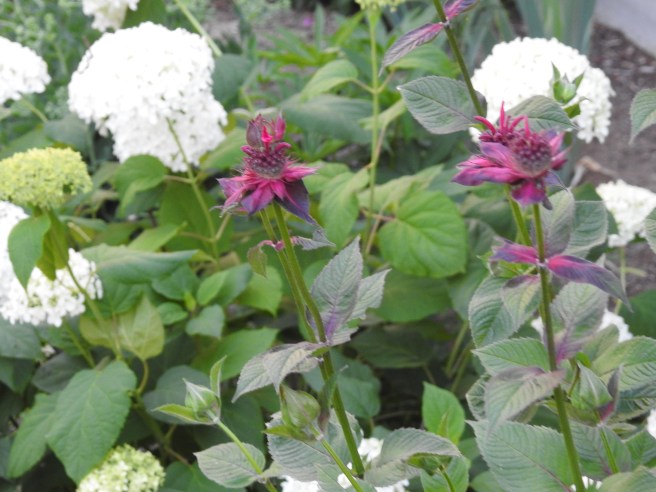
On two sides of the house we have flowers and shrubs and tonight my eye was drawn to movement in the bee balm. I thought I was looking at one rather large bee and so I decided to grab the camera and go out to capture a shot. Once I got my camera focused I realized that what I was looking at was not a bee. Turns out I had a hummingbird moth in my bee balm.
Want to learn more about these moths? See http://www.fs.fed.us/wildflowers/pollinators/pollinator-of-the-month/hummingbird_moth.shtml
I’m not certain whether I saw a hummingbird clearwing or a snowberry clearwing. Bragging rights to any one out there who cares to spend the time making the detailed analysis and comparison necessary to call it one way or the other. Me – I’m not doing it. I’m just glad to have seen a new outdoor friend today.
Meltdown

Yesterday temperature readings were above 90 in much of Maine. Today is shaping up in similar fashion. We’ll miss this in a few months.
I’d say go sit under the sprinkler, but much of Maine is under drought conditions and state officials have asked us to make careful, wise use of our water resources.
Whirligig Beetles (Family Gyrinidae) – They spend their days swimming in circles on the water’s surface. Similarly, I spend my days running in circles – or so it seems at times.
Our little piece of heaven is drying up faster than we’ve ever seen. Thinking of starting a muck bath business.
Got fish?
Watched an osprey hovering for what seemed like an impossibly long time while searching for fish.


The Little Things
Not a lot of time for shooting lately. Managed to catch a few photos of this bird yesterday morning. (The clever folks on MAINE Birds think it is either a molting or a juvenile bluebird. I vote juvenile.) I noticed him (her?) flitting in the tree line after an Eastern Bluebird on the hammock caught my eye.

Went down to the lake last night after walking the dogs and snagged photos of these three birds. Not my best work, but I was smiling.
Owls are up to their usual tricks at night.
The lake is lower than we’ve ever seen it, though we’ve only been watching for three summers now. If it gets much lower the boat will be sitting in muck and we’ll pretend the tide has gone out.
Speaking of pretending, can we all agree not to notice that the days are getting shorter?
Went for a Sunday visit to the family camp on China Lake. Neighbors a few doors down on each side of my grandmother’s camp remarked that “the bats are back.” Did you know that Maine’s bats have been dying because of a disease called white-nose syndrome? In fact, millions of bats in eastern North America have been dying from this disease. Check out https://www.whitenosesyndrome.org/what-can-you-do-help to learn more about the disease and what steps you can take to help bats in your area.
I’m sitting on the back deck typing this. Ten more minutes and the sun will be below the tree line. A small dog sits on my lap, pawing at my arm when I pause for too many seconds to type rather than stroke her chest. Birds seems to be settling in for the night, and the loons are calling periodically. A slight breeze is waggling the leaves. The setting sun is turning my green forest golden.
A plane just flew over. I hear a speed boat cutting across the lake.
The osprey juveniles are calling for food. Again. I wonder when their parents evict them?
The Things We’ve Lost Forever

Today is the fifth anniversary of my father’s death. I am sad.
We all have them: Sorrows, troubles, heartaches, challenges. If our biggest challenge is a remodel of the house we are blessed. If we are raising a grandchild because cancer stole our daughter, Lord Jesus give us the strength to get out of bed in the morning. If we lost a baby the day he was born, and don’t believe in God, may we dig deep for the courage to keep going. If we can’t see our way out of the dark, may we still keep our eyes open and searching for a light.
Naughty children. Arthritic toes. Aging parents. Empty bank accounts. Crushing debt. Dead-end jobs. No jobs. Another mill shuttered. Bad test results. A broken heart. A lump. An accident. The front page horror that is your own. A broken home. One more drink. Black lives matter. All lives matter. Nobody can begin to understand what’s the matter. A gun, a gun, another gun. Her black eye, his bruised knuckles. The secrets that we keep. The dog in the crate all day, all day, all day, all day.
Humble me, Lord. How can we think of saving the planet when we cannot save ourselves?
Indulge me:
Brent Cecil. When the end came, he was alone. Or at least I think it is extremely likely that he was, for two reasons: First, if someone had been there when he’d crashed (slumped? slipped?) to the floor, they probably would have gone for help, unless they were too trashed to notice. (Such is the range of humanity in a facility built to house the most vulnerable of the chronically homeless, with a focus on “housing first” and sobriety perhaps never.) Second, and more likely, my father was alone because that was his preference.
At his funeral, after the dough-faced minister had gone and the small gathering had dispersed, my mother called her children to her in the tone she used when we were young and believed that our parents knew best. She stood near the hole that would cradle my father in death. I don’t remember how his urn – a teak wood box that my brother crafted – got into the hole, but she lifted it up and tossed her sweetheart ring gently beneath it, and then I placed a picture of our family, a relic from twenty-five years ago, on top of the box.
Five faces stared back at us: my mother with a calm smile, holding my baby sister, who beams with unbounded joy; my older brother, smiling, too, but with a question in his eyes; me, sandwiched between my parents, smiling the trusting smile of a little girl who doesn’t know what life is going to do to her; and my father – not smiling at all, his ice-blue eyes staring into a distance that none of us would ever understand.
Tomorrow is a fresh day.
In the Kundalini tradition of yoga, one of the most powerful mantras is SA, TA, NA, MA:
SA is the beginning, infinity, the totality of everything that ever was, is or will be.
TA is life, existence and creativity that manifests from infinity.
NA is death, change and the transformation of consciousness.
MA is rebirth, regeneration and resurrection which allows us to consciously experience the joy of the infinite.
This week at work, I had several clients share personal stories of horror and heartbreak that made me grateful for my story of sorrow. Children lose parents every day: accidents, illness, abandonment. Suicide is not an acceptable avenue of departure from this earth, save perhaps for the terminally ill. So if your father points a gun at himself and pulls the trigger, or pours poison down his throat until his liver quits, you mourn your loss quietly and with a sense of shame – you are your father’s son, and you are your father’s daughter, are you not? No. No. No.
Tomorrow is a fresh day.
So first, do no harm. And then do one better and make a difference in somebody’s day. What can you give tomorrow to make your existence more meaningful? A smile to a stranger? A silent blessing to someone who is struggling? A piece of litter picked up and thrown away? Five miles per hour slower and move over a bit more for the guy on the bike?
With each passing day we lose something that we’ll never get back. Time passes, bodies age, flowers die. But we are here. And we have choices. Make them count.
This week I have seen the nature of Maine in different guises. This is a hard life. And a hard state to make a living in and to just plain live in. And it seems silly to worry about weedy lakes when we are still paying last winter’s oil bill. But Maine is nothing without its natural beauty, and so those of us who can care must.
For a list of Maine’s endangered or threatened species check out: http://www.maine.gov/ifw/wildlife/endangered/listed_species_me.htm
For a discussion of the fact that 2016 is on pace to be the hottest year on record, see http://www.cnn.com/2016/06/18/health/2016-global-heat-noaa-report-irpt/.
To understand about the connection between climate change, drought, and wildfires, see http://www.scientificamerican.com/article/climate-change-fingerprints-are-all-over-california-wildfires/
Tomorrow is a fresh day. Humble me, Lord.
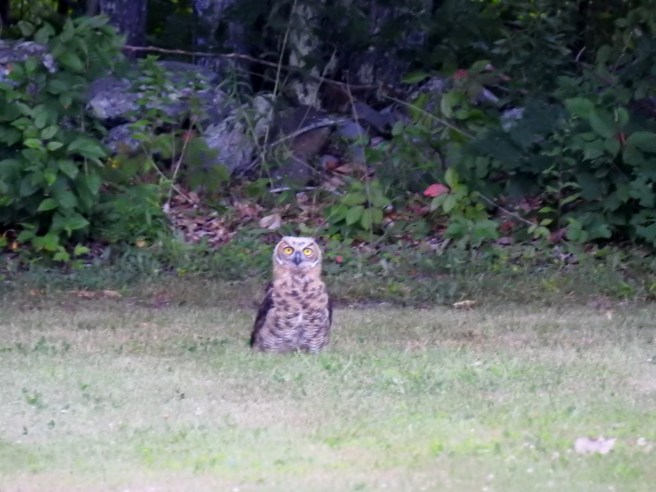
And thank you, Mr. Owl, for landing on the edge of our property and staying long enough for my husband to see and hear you.

Birds of Maine
Culprit confirmed, and other miscellany
A week of silence in the woods had me hurt and confused – where had my Up-All-Night-Screamers gone? Well, for the past few nights I am delighted to say that husband’s sleep is once again being punctuated by the sound of at least two owls swooping around in our mini-forest. Hooray owls! So glad to hear you back. I’m not sleeping anyway, so I’m game for the company. (And because my schooling as an attorney has taught me to check and recheck my facts before reaching a conclusion, the photo above was taken tonight after prowling around in the woods with my camera, listening and watching and finally standing underneath the tree where this juvenile made a few of the screaching noises I hear all night long.)
These are pictures of a patch of milfoil growing near my waterfront. (Hooray for resale value!) I have learned from the lovely folks at Cobbossee Watershed District that this patch of milfoil is native milfoil – not variable-leaf milfoil, which is the bad stuff that many volunteers are hunting for. Still, to ride over this expanse of weeds is to involuntarily gasp, “Oh my….oh….my…..” It is impressive and horrifying. Check your boat before it floats people!
This weekend we had about a dozen seagulls passing the time of day at the lake. Apparently they’ve grown tired of the beach already. The crowds can be a bit much.
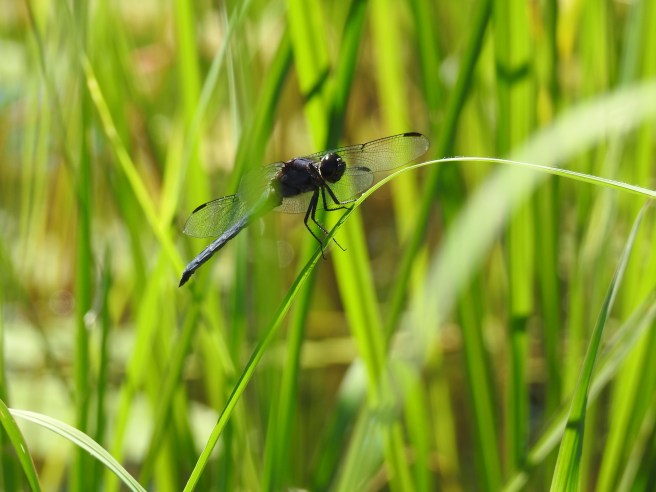
I’ve previously noted that dragonflies and hummingbirds make me nervous because I don’t like being darted at. (Pretty sure that is horrible sentence construction but I’m sticking with it.) So you know I was sorely lacking in something else to point my camera at when I started trying to get a good shot of this black beauty. And honestly, I can’t tell you how often I’ve seen one dragonfly eating the head of another. There, I’ve said it. The truth hurts, and life in the weeds is brutish and short. Never thought I’d hear myself say, “Get off! You aren’t using my foot to eat his head.” Right. Dragonflies resting on my pretty little toes. To eat a small snack of Other-Guy’s-Head.

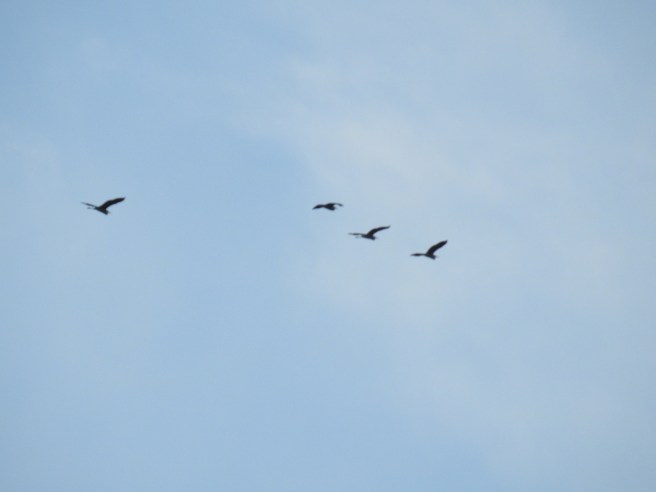
First time I’ve seen four great blue herons fly overhead together. Not a great shot but I took it anyway.

Still learning to shoot the moon.

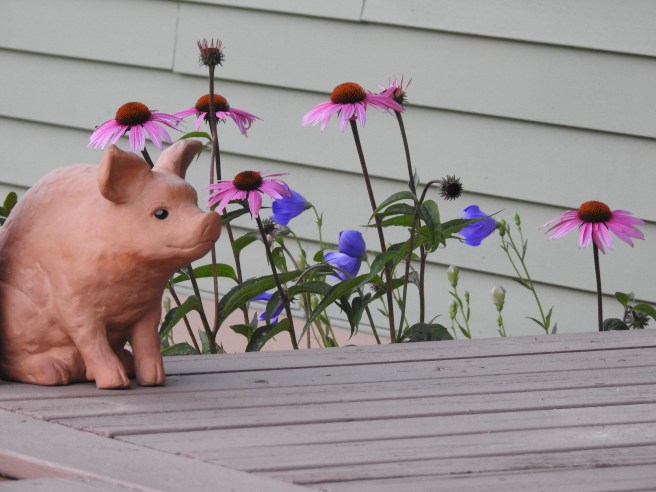
Tickled pink that flowers are growing near the house.

Will never, apparently, tire of my “pet” pig. His perpetual grin is the real charm.
Fifty Shades of Green

Five generations of my family have had the privilege of creating summer memories on China Lake. One of my enduring childhood memories of the lake is that it turned pea-soup green every summer. Known as “China Lake Syndrome,” the annual algal blooms were the result of too much development too fast, leading to the leaching of nutrients into the lake. Too many nutrients (phosphorus) created an imbalance in the lake’s bacteria levels and the result was algal blooms – or a green lake. (For a more scientific explanation of algal blooms check out Maine DEP’s discussion of cyanobacteria at http://www.maine.gov/dep/water/lakes/cynobacteria.htm).
A July 15, 1991 article in the Lewiston Sun Journal makes mention of the so-called “China Lake Syndrome,” using China Lake’s experience as a warning to readers about the damage done to a lake when we allow run-off from farms and lawn fertilizer and leaking septic tanks to pollute our lakes. Indeed, the title of this 1991 article is “Day-to-day Actions Can Damage Maine Lakes.” Included in this article are tips on caring for Maine’s nearly 6,000 lakes and ponds, such as not spraying herbicide on submerged vegetation, and not bathing in the lake. Today these points seem obvious, but I remember my father used to clean up in the lake with a bar of Lava soap, and the two generations of women in my family that preceded me routinely shampooed their hair in the lake.
Today, after a great deal of research and effort, China Lake is slowly mending, or at least not getting worse. This morning the China Lake Association (formed in 1987) held its annual meeting. Although listed last on the agenda for today’s meeting, I would bet that the discussion of the Alewife Restoration Initiative (http://mainerivers.org/projects/china-lake-outlet-stream-restoration/) was the hot topic of the morning. The scientific premise behind alewife restoration is that young alewives will improve China’s water quality as a natural consequence of their diet: alewives eat phosphorus as they move from the lake to the ocean. Removing excess phosphorus means decreasing the severity of algal blooms. The goal, then, is to create an environment (through dam removal) that will allow for alewives to return to China Lake by the hundreds of thousands (nearly one million, actually).
The near death of China Lake did not occur over night, and it is not an uncommon problem. The Belgrade Lakes, a chain of seven lakes and ponds in Central Maine, are being closely monitored in light of a 40 year trend of declining water quality. Last July, the Belgrade Lakes Conservation Alliance, the Maine Lakes Resource Center, Colby College and the landowner associations on each of the seven lakes joined forces to address the continuing decline in water quality. (See http://www.centralmaine.com/2015/07/26/belgrade-lakes-water-quality-could-dive-in-a-decade/ for details.) See an interactive map hosted by the Maine Lakes Resource Center (http://www.mapsforgood.org/mlrc/) for a look at data collected as part of this initiative.
I take my hat off to the people across our state who have volunteered time to help watch over “their” lakes and ponds. Interested in getting involved on a lake association in your area? Even if you do not live on the lake or pond, I would be shocked if your interest in getting involved was unappreciated. Go to http://mainelakessociety.org/maine-lake-associations/ for an alphabetical list of lake associations in Maine.
At last light
Around 7:45 tonight we were just home from walking the dogs when a pair of herons flew over, headed for Maranacook Lake or the Upper or Lower Narrows Ponds, I’m guessing.
Since the sunset was painting the woods with irresistible light I decided to take a few minutes with my camera in the woods. My husband had already gone in with the girls (dogs) so I called to him through the open windows.
“I’m just going for a bit” was met with “Don’t be forever or we’ll lock you out!” This translates to “Be safe, please, and use your head” in Husband-Speak. Truly. I’ve known this guy half a lifetime now. He’s a keeper, but not a Hallmark Card writer.
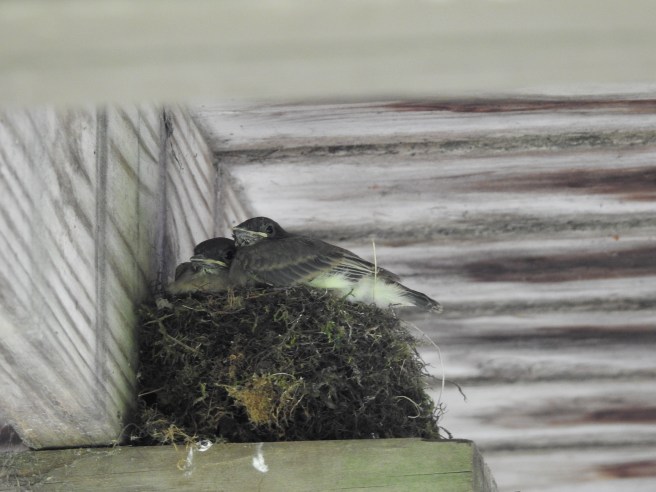
On my way across the lawn I remembered to check on the phoebe fledglings. The photo below is from Saturday, the first time I’d seen them up out of the nest. Tonight, they are gone.

The parents that have worked so hard, and so visibly (see Lunch, phoebe style), to feed this brood of three have left just a quickly. I hope that all members of this phoebe family are nearby, and well. I will be watching the backyard for them.
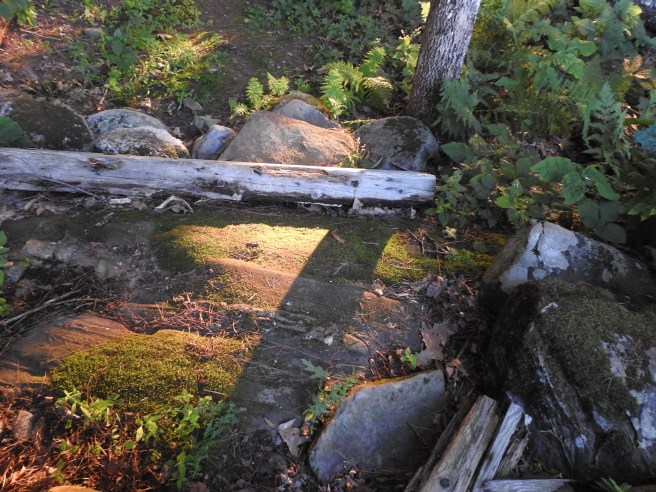
With the sun quickly sinking, and nothing but an empty nest to frown at, I kept moving toward woods and lake. To get to our waterfront we climb down a fairly steep (45 degrees?) incline of boulders and railroad ties (which were rotting in the field when we moved in). This is a difficult access route for many people we love dearly, but we do what we can with the resources we have, and talk in terms of “one day.”
So over the boulders and through the woods I went, scanning for the deer whose white tail went slipping through the trees on Sunday, and still peering into tree tops for the lumps of owl that can be so difficult to see.I found a robin and weeds bathed in the last of today’s sun, but little else. (Surely there was plenty more to discover but tonight I could not take the time.)
I did not take any photos of tonight’s full moon but I took a few last night. Here they are: